 MY BOWLING JOURNEY
Pin Up, Pin Down: Drilling Layouts Explained Without a Protractor
By Ryan · · Equipment · 5 min read
Every bowling ball has a tiny colored dot on it. Most people never notice it. Bowlers who have noticed it can talk about it for 45 minutes without taking a breath.
That dot is called the pin. Where your pro shop drills your finger holes in relation to that dot changes how the ball moves down the lane. That's the whole idea behind a drilling layout.
I'm going to explain it without a single protractor, mostly because I'd lose it.
The engine inside the ball
Remember from the solid versus pearl post: the coverstock is the tires and the core is the engine. The core is a weighted shape inside the ball, and the pin marks where the top of that core is.
When your pro shop drills the holes, they're deciding how that engine sits in your hand. Turn the engine one way, the ball revs up early and rolls smooth. Turn it another way, the ball skids farther and then turns hard.
Same ball. Same cover. Different holes. Different ball.
Pin up and pin down
This is the simplest way to start.
Pin up means the pin ends up above your finger holes, closer to your fingers. In general, a pin up layout makes the ball go a little longer down the lane and turn harder at the end.
Pin down means the pin ends up below your finger holes, closer to your thumb. A pin down layout usually makes the ball start to roll earlier and move more smoothly.
That's it. That's the starter version. You now know more than most people bowling in your league, and you can use that power responsibly or annoyingly. I picked annoyingly years ago.
Your PAP, explained like a person
PAP stands for positive axis point. Fancy name, simple idea.
When you throw a ball, it spins around an invisible axis, like the earth spins around the North Pole. Your PAP is where that pole sits on your ball, measured from the middle of your grip.
Everyone's PAP is a little different, because everyone throws a little differently. Mine is 4 inches to the right and three quarters of an inch up. I'm not a math person. I just know my number, and now so do you.
Your PAP matters because a layout is really about where the pin sits compared to your PAP. That's why two bowlers can ask for "the same layout" and end up with two very different balls.
The numbers you'll hear
When you start reading about layouts, you'll see three numbers, like 50 x 4.75 x 40 (that's my Ion Max Solid). They describe angles and distances between the pin and your PAP.
You don't need to memorize these. Here's the one-sentence version: a smaller first number usually means an earlier, smoother ball, and a bigger first number usually means a longer, sharper ball.
My Storm Bionic Hybrid is drilled 35 x 4.25 x 40, the smoother, earlier kind. My Storm Phaze II Pearl is drilled 60 x 5 x 45, the longer, sharper kind. One rolls early and steady. The other skids and then makes a move. Same bowler, very different jobs. My Road Warrior Pearl is drilled 70 x 4.5 x 45, the longest of the bunch, which is a lot of layout for a ball that spends most nights watching from the bag.
The redrill that saved a ball
Here's my favorite layout story.
My Storm Ion Max Solid didn't start out as a favorite. I had it redrilled with a 50-degree drilling angle, and it came back a dramatically better ball. Same cover. Same core. New holes. Suddenly it was one of the best balls in my bag.
So if you have a ball that never seems to work, don't give up on it right away. Sometimes the ball is fine and the layout is wrong for you. A redrill costs a lot less than a new ball, and you get to tell everyone you "rescued" it. That's worth something.
Fit matters more than any layout
Before you get deep into angles, here's the most important part. A ball that doesn't fit your hand will never do what the layout promises.
A good pro shop will measure your span (how far apart the holes are), the pitch (the angles of the holes) and the size of every hole. They'll ask how fast you throw and how much the ball hooks for you now.
I put a switch grip thumb insert in every ball I own, so the thumb hole feels the same from ball to ball. When I pick up a different ball in the middle of a set, I want the only difference to be how it moves, not how it feels in my hand.
What to tell your pro shop
You don't need to walk in speaking in degrees. Just tell them:
- What lanes you usually bowl on (a house shot at your center, or sport patterns).
- What your current ball does that you don't like. Too early? Too late? Not enough turn at the end?
- What you want this new ball to do for you.
- Your PAP, if you know it. If you don't, they'll find it.
Then trust them. This is their job, and they've seen worse throwers than you. They've seen me.
Seeing the difference a layout makes
Here's my honest problem with layouts. When a ball feels different, I can never tell if it's the layout, the lanes, or just me having a good night.
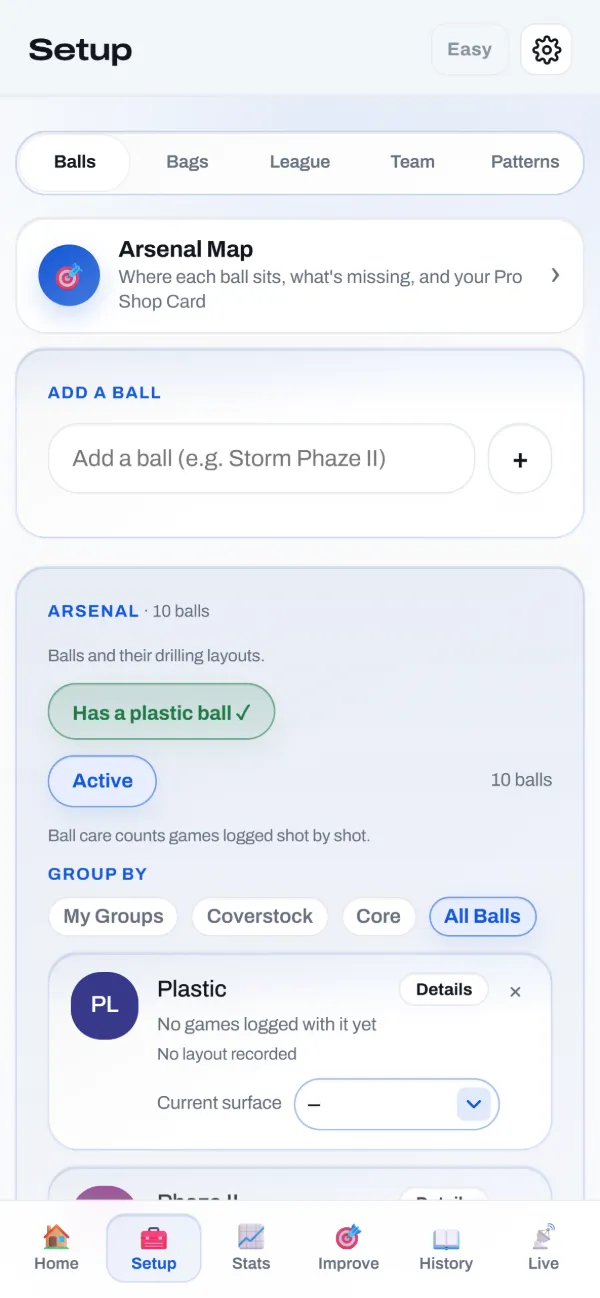
In My Bowling Journey you can add every ball with its layout and surface, so your stats break down ball by ball.
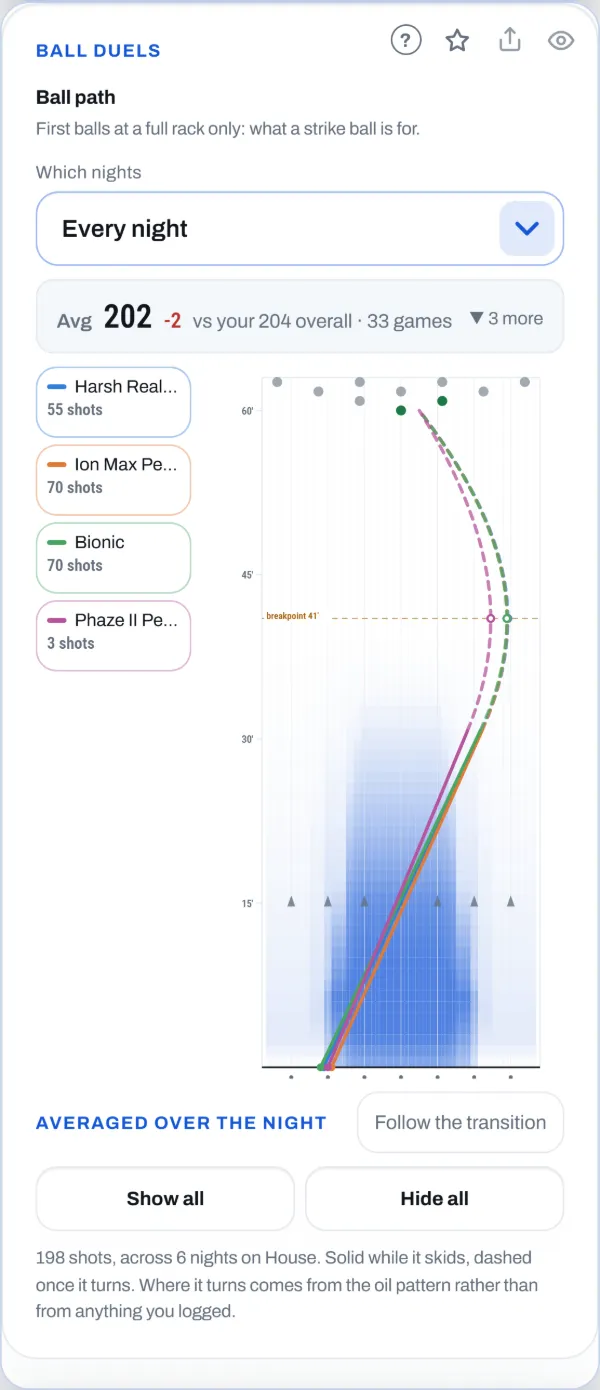
Ball Duels draws the path of your first balls on the lane, ball by ball, with where each one starts to turn. Put two balls on the same lane and you can actually see the difference between an early, smooth layout and a long, sharp one.
And if you log your speed, rev rate, axis rotation and tilt, Delivery DNA shows your usual numbers, which is exactly what your pro shop wants to know.
The bottom line
The little dot matters. Pin up is usually longer and sharper. Pin down is usually earlier and smoother. Your PAP is where your ball spins, and the layout is all about where the pin sits compared to it.
But you don't have to master any of this. Find a good pro shop, tell them what you want and get a ball that fits.
Then you can spend the next 45 minutes explaining it to your teammates. They'll love it. They won't.
Keep every ball, layout and surface in one place with My Bowling Journey. Free on Google Play.