 MY BOWLING JOURNEY
The 10 Pin Hates You. Here's Why, and How to Get Even.
By Ryan · · Scoring · 5 min read
If you're right-handed, there is one pin in your life that is personally out to get you. It lives in the back right corner. It's the 10 pin.
You throw a great shot. It hits the pocket. Nine pins explode. And there it stands, all alone, perfectly still, like it didn't even hear the noise.
Lefties, you have the same relationship with the 7 pin. Everything in this post works for you too. Just flip it.
Why the 10 pin stays up
To get a strike, the pins have to knock each other down in a chain. Your ball only touches four pins on a perfect strike. The other six get taken out by flying pins.
The 10 pin is supposed to be knocked down by the 6 pin. When the 6 pin does its job, you strike. When it doesn't, you're staring at the 10 again.
There are two very different ways the 6 pin can let you down, and they mean very different things.
The weak 10
A weak 10 is when the 6 pin flops over and slides into the gutter without ever reaching the 10. It's a pin that just gave up.
Usually that means your ball ran out of energy by the time it got to the pins. It may have hooked too early and gotten tired. It may have hit the pocket a little light and deflected. Either way, the ball didn't drive through the pins hard enough.
A weak 10 is a message. It's telling you something about your ball, your speed or your line.
The ringing 10
A ringing 10 is when the 6 pin flies hard off the side wall and somehow goes right around the 10 pin. It's loud. It's violent. And the 10 pin just stands there, wobbling, like it's laughing at you.
A ringing 10 often comes from a shot that was actually pretty good. You hit the pocket hard. The pins just bounced the wrong way.
This is important, because bowlers react to a ringing 10 by changing everything. New ball. New line. New attitude. Sometimes the right answer is to throw the exact same shot again and let the odds even out.
The trick is knowing which kind of 10 you're leaving. If you keep leaving weak ones, change something. If you're leaving ringing ones, take a breath before you start rebuilding your game in the middle of game 2.
My personal 10 pin era
Last season I had a 10 pin problem. Not leaving it, although I did plenty of that. Making it.
I'd leave the 10, walk back, pick up my spare ball, and miss it. Not every time, but way more often than someone with my average should. The 10 pin wasn't just beating me. It was embarrassing me in front of people I bowl with every week.
The good news is that I fixed it. This season the 10 pin and I have a working relationship. We're not friends, but we're civil. I still leave plenty of flat 10s, as my teammates will tell you without being asked.
How to start making the 10
Here's what works for most bowlers:
- Use a plastic spare ball. Plastic barely hooks. Your strike ball wants to curve, which is the last thing you want when the pin is in the corner next to the gutter. A plastic ball goes where you aim it.
- Cross the lane. For a right-hander, stand on the left side of the approach and throw across the lane toward the 10 pin. That gives you the most room for error. If you throw from the right side, you're throwing straight down the edge of a cliff.
- Throw it straight. Don't try to put spin on it. Walk to the line, look at your target and roll it at the pin.
- Pick a target on the lane, not the pin. Most bowlers aim at the arrows on the lane, not at the pins 60 feet away. A small target close to you is easier to hit than a small pin far away.
- Do the same thing every time. Same spot, same target, same ball. Spares are the one part of bowling where boring is the goal.
Making your spares is the fastest way to raise your average. You can't control whether the 6 pin goes around the 10. You can control whether you pick it up.
Finding out how much the 10 is costing you
Here's the problem with the 10 pin. You remember the ones you missed in big moments, and you forget the twenty you made without thinking about it. Your memory is a terrible scorekeeper.
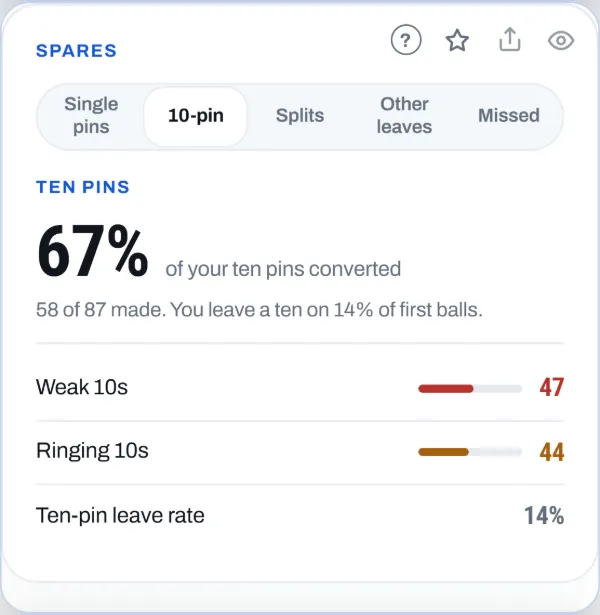
My Bowling Journey keeps track of it for you. When you tap the pins you left, the app knows every 10 pin you left and whether you made it. The 10-pin tab on the Spares card shows how often you leave the 10, how often you convert it, and whether it was a weak 10 or a ringing 10.
10 Pin Toll goes after the bigger question: what does the 10 pin cost you? It compares your average series on nights with few 10 pins against nights with many, and splits weak 10s from ringing 10s.
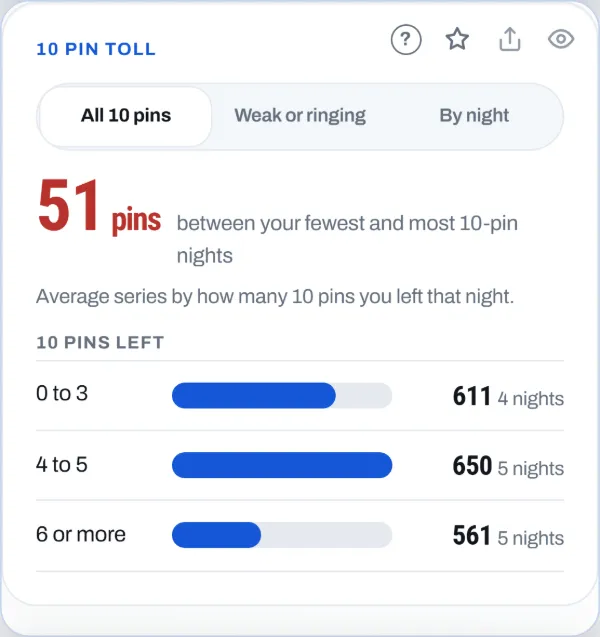
The first time you see that difference, you will go straight to the practice lanes. Or you'll go straight to the bar. Either is a valid response.
The bottom line
The 10 pin isn't really out to get you. It's just sitting in the worst spot on the deck, waiting for a 6 pin that doesn't always show up.
Learn the difference between a weak 10 and a ringing 10. Get a plastic ball. Cross the lane. Make it boring.
And when you leave one after the best shot of your night, just know that somewhere, a guy on a team called Good Enough is leaving one too.
See what the 10 pin is really costing you with My Bowling Journey. Free on Google Play.